The Treaty of Versailles, negotiated by the fractious Allies in the wake of the First World War, did not crush Germany, nor did it bring her back into the family of nations. Antony Lentin examines a tortuous process that sowed the seeds of further conflict.
Pic: Crowds line the streets of Berlin as German soldiers return, hailed as 'undefeated', at the end of the war, 1918Crowds line the streets of Berlin as German soldiers return, hailed as 'undefeated', at the end of the war, 1918. Corbis/Stapleton Collection
Nearly a century on, perceptions of the Paris Peace Conference and the Treaty of Versailles still bear the imprint of The Economic Consequences of the Peace by John Maynard Keynes (1883-1946), which became a bestseller in the wake of the conference. Bitter fruit of Keynes’ own experience as a delegate in Paris, the book condemned what he branded ‘the Carthaginian peace’. The expression was suggested to Keynes by the South African delegate, General Jan Smuts (1870-1950), who referred to the peace concluded in 201 bc after the Second Punic War, when Rome stripped Carthage of its army, navy and overseas possessions and imposed a 50-year indemnity. Otherwise Carthage was left independent and able to recover economically, which eventually it did. Keynes actually seems to have been thinking of the ‘peace’ of 146 bc, when, after the Third Punic War, the Romans slaughtered the inhabitants of Carthage or sold them into slavery, annexing what remained of Carthaginian territory. In The Economic Consequences of the Peace Keynes quoted and endorsed the German view that the Treaty of Versailles signalled ‘the death sentence of many millions of German men, women and children’.
The book was widely translated, has never been out of print and has never lost its authority. Its success may be attributed to Keynes’ reputation as an economist and the brilliance with which he conveyed the disenchantment shared by many of his colleagues in the British delegation. Neither the acute and prophetic analysis published soon after, Jacques Bainville’s Les conséquences politiques de la paix (1920), which has never been translated into English, nor the detailed refutation of Keynes by Etienne Mantoux, The Carthaginian Peace or The Economic Consequences of Mr Keynes (1944), succeeded in stemming its influence, though while none of Keynes’ predictions were realised almost every one of Bainville’s were. More recent research contained in two collections of scholarly papers has fared little better. William Keylor, in his contribution to The Treaty of Versailles 75 Years After (1998), and Zara Steiner in ‘The Treaty of Versailles Revisited’, published in The Paris Peace Conference, 1919: Peace without Victory (2001), strove to correct what Steiner calls ‘the misused image of the “Carthaginian” peace’. In The Lights that Failed: European International History 1919-1933 (2005) Steiner repeats that ‘the traditional view’ of Versailles ‘needs to be abandoned’. But still historians have failed to break the Keynesian spell. Is the accepted image wholly illusory, or does it express an aspect of the truth about the peace treaty?
After the ‘war to end war’ extravagant hopes were raised by the Paris Peace Conference, the first and greatest ‘summit conference’ of modern times. Even before the conference opened President Woodrow Wilson, en route from the United States, feared that it might end in ‘a tragedy of disappointment’. At its height, more than a thousand statesmen, diplomats and their staff, representing some 30 nations, were engaged in the business of peacemaking. The British delegation alone numbered over 200. Among them was Harold Nicolson, a junior diplomat who later published another classic of disillusionment, Peacemaking 1919 (1933). Nicolson recalls the conference resembling ‘a riot in a parrot-house’. Fifty-two commissions met in 1,646 sessions to draft reports on subjects ranging from prisoners of war to undersea cables, from the internationalisation of the Kiel Canal to responsibility for the war, all incorporated in a treaty extending to 15 chapters and 440 clauses.
The conference eclipsed any other in the scope of the responsibilities it undertook, with the frontiers of a new Europe of nation states to delineate and treaties to conclude with Austria, Hungary, Bulgaria and Turkey, as well as with Germany. But progress suffered badly from the want of a basic organisational plan. Both Wilson and the British prime minister, David Lloyd George, mistrusted traditional diplomacy, which they believed had contributed to the outbreak of the war. They and the French premier, Georges Clemenceau, insisted on keeping both the shifting agenda and the conduct of negotiations in their own hands.
Wilson sought to establish the League of Nations, his panacea for world peace, as part and parcel of the peace treaties. The opening weeks of the conference were devoted to drafting the constitution, or Covenant, of the League. At the same time a council consisting of the five Allied leaders (of France, Britain, the US, Italy and Japan) and their foreign ministers sat through lengthy presentations of territorial claims from spokesmen of the new states. Clemenceau’s object was above all to ensure the future security of France against Germany, which he was sure would be intent on revenge. For Lloyd George the priority was reparations, which turned out to be the most time-consuming and divisive of all the problems faced.
Nicolson thought the lack of a systematic agenda vitiated the conference from the outset. Instead of getting to grips with the long-term challenge of Germany, the peacemakers found themselves struggling to cope with the distracting sideshows of a dozen minor wars and several sporadic and short-lived Communist revolutions. At the same time they were under domestic pressures from what Lloyd George called ‘the too fierce ardour of an expectant public’. He himself had done much to fan the flames with his electoral pledges to ‘make Germany pay’ and had to return periodically to London to face raucous backbenchers in his Conservative-dominated coalition. Wilson, too, returned temporarily to Washington for the opening session of a Congress dominated by his isolationist Republican opponents, whose suspicions of the League of Nations he failed to allay. Clemenceau was also briefly out of action when an assassination attempt left a bullet in his chest.
Not until the end of March 1919 – fearing that the example of Bolshevism in Russia might prove irresistible to a volatile Europe craving stability, work and bread – did Lloyd George, Wilson, Clemenceau and, to a lesser extent, Prime Minister Orlando of Italy, attempt to grasp the nettle of peace with Germany in ‘a race’, said Wilson, ‘between peace and anarchy’. Accompanied only by interpreters and advisers and meeting daily in 145 private sessions between late March and June, they took all the main decisions themselves as the Supreme Council or ‘Big Four’: ‘Four men’, said Lloyd George, ‘endeavouring to make the world spin round the way it should’.
It was from these closed sessions in stuffy rooms across six weeks of intensive bargaining that the treaty with Germany emerged as a set of improvised arrangements between Allies with different and often conflicting aims on such contentious territorial issues as Danzig, the Saar and the Rhineland, over which they deliberated at length. At various times one or other would stalk out of the room, threaten to leave the conference, or in Orlando’s case, to do so: the Big Four became the Big Three. ‘How did you get on?’ Clemenceau was asked after one stormy session with Wilson. ‘Splendidly’, he replied. ‘We disagreed about everything.’ On another occasion Clemenceau came close to blows with Lloyd George, whom he accused, not without cause, of serial duplicity. Wilson, exasperated at the demands of both Clemenceau and Lloyd George, ordered the SS George Washington to prepare for his early return. They all stuck it out – Orlando came back in the end – accepting that compromise was inevitable if the conference was not to collapse; but the compromises reached only after immense difficulty and heart-searching were between the Allies, not between them and Germany
The whole package of terms was approved unamended by the Big Three without adequate co-ordination or review in order to meet a self-imposed deadline of May 7th for presentation to the Germans. Even on May 6th the details of these ‘preliminaries of peace’ had not been collated in a single document and assorted sections were still passing to and from the printers. No one had read them in full let alone discussed their cumulative effect. ‘I hope’, said Wilson ingenuously, ‘that during the rest of my life I will have enough time to read this whole volume.’ Lloyd George admitted that he only received a complete copy at the last moment. ‘I don’t think in all history this can be matched’, commented Sir Henry Wilson, Chief of the Imperial General Staff.
In his 14 Points Wilson had pledged himself and the Allies to a ‘peace of justice’. This required the implementation in Europe of the principle of national self-determination through the creation of nation states and the establishment of a ‘new world order’, as Wilson called it, based on the League of Nations and the re-ordering of international relations under the rule of law. This vision had to be reconciled with the demands of allies who had lavished blood and treasure for most of the war, while America remained profitably neutral. They were not going to be talked out of compensation, security and gains at the expense of a still powerful Germany, which had defeated Russia and come close to victory.
The Treaty of Versailles confiscated all of Germany’s overseas possessions and at least a tenth of her territory, population, agricultural land, coal, iron and steel. It reduced her army of half a million conscripts to a volunteer defence force of 100,000 and her fleet to little more than a coastal command. It saddled Germany with liability for a vast yet unquantified reparations debt, which it was reckoned would take a generation or more to discharge. To compensate France for the deliberate destruction of her coalmines it transferred the coal-rich Saarland to her for 15 years. All German territory on the left bank of the Rhine and a 50-kilometre strip on the right was declared a demilitarised zone, barred to German troops in perpetuity and placed under Allied occupation for a dozen years.
The Treaty also imposed what the Germans called Schmachparagrafen, ‘clauses of shame’, notably the projected trial of the ex-Kaiser for ‘a supreme offence against international morality’ and Article 231, which asserted Germany’s liability for the loss and damage caused by her ‘aggression’. The Germans immediately denounced this as a ‘war guilt clause’, which stamped the entire treaty with the intolerable character of a Schandvertrag or ‘treaty of shame’.
Versailles was a dictated peace, or Diktat. A German delegation was summoned to Versailles to receive, though not to negotiate, the draft conditions on May 7th. Two reluctant envoys were sent from Berlin to sign the final treaty on June 28th at the Palace of Versailles, in the same Hall of Mirrors where the German Empire had been proclaimed in 1871. These were the only occasions on which the Germans were allowed to make an appearance. But this had not been the original plan. The conference had opened in January as an inter-Allied gathering, assembled to agree a common policy and to formulate initial demands for subsequent discussion at a full congress with Germany in accordance with the norms of European diplomacy. By early March, however, it was apparent that agreement even among the Allies would be difficult. Hence negotiation with Germany was ruled out for fear that it would lead to unravelling hard-won decisions. Accordingly on May 7th the terms were formally presented to the Germans on a ‘take-it-or-leave-it’ basis at the Hotel Trianon at Versailles. Here Clemenceau, as president of the conference, set the tone with an uncompromising declaration of intent. ‘The time has come for a heavy reckoning of accounts’, he told the Germans. ‘There will be no verbal discussion, and observations must be submitted in writing.’
The German delegation had one opportunity to represent the Weimar Republic and to show the Allies, who knew little about the new Germany, a human face. Unfortunately the head of the delegation, the foreign minister, Count Ulrich von Brockdorff-Rantzau, made a poor impression. ‘A most sinister-looking person’, wrote one observer, ‘an incarnation of the whole Junker system.’
Worse still was Brockdorff-Rantzau’s presentation, delivered seated in a rasping tone and defiant manner. Far from persuading the Allies, its effect, as recorded by Philip Kerr, Lloyd George’s secretary, was to provoke their united antipathy:
At the start everybody felt a little sympathy with the Hun, but by the time Brockdorff-Rantzau had finished, most people were almost anxious to recommence the war.
‘Insolent beyond description’, said Lloyd George. He ‘felt he could get up and hit’ Brockdorff-Rantzau. Wilson agreed that it was ‘the most tactless speech I have ever heard’. Clemenceau kept his temper ‘but his face became red with anger’. The count’s demeanour and conduct gave the fatal impression that the new Germany was not so different from the old. Six weeks later this impression seemed to be confirmed when the German High Seas Fleet, interned at Scapa Flow under the terms of the Armistice, scuttled itself. The peacemakers saw this as proof of perfidy and it further hardened their attitude. Wilson spoke for all in demanding from Germany ‘an unequivocal decision … to sign or not to sign’.
Rather than sign, Brockdorff-Rantzau, his fellow delegates and the first government of the Weimar Republic resigned. In the words of the outgoing chancellor, Philip Scheidemann: ‘What hand would not wither that binds itself and us in these fetters?’ A new cabinet was formed and the constituent assembly at Weimar approved its recommendation to accept the treaty under pressure of the ongoing Allied blockade, the threat of an Allied march on Berlin and the fear that the Bismarckian Reich, not yet 50 years old, would disintegrate as its component states made separate peace with the advancing Allies. Friedrich Ebert, president of the republic, announced the government’s decision to sign, ‘yielding’, as he said, ‘to overwhelming force, but without on that account abandoning its view in regard to the unheard-of injustice of the Treaty’. This emphatic reservation explains much about the sequel.
Brockdorff-Rantzau described the treaty as a ‘death sentence’. Clemenceau’s view was: ‘If only we could get rid of Germany, there would be peace in Europe.’ The point, as the peacemakers acknowledged, was that they had no intention of breaking up the German Reich. ‘We do not wish to destroy Germany,’ Wilson confirmed, ‘and we could not do so if we wished.’ German prosperity was essential if reparations were to be paid and Lloyd George warned against killing the goose that he hoped would lay the golden egg. He wanted Germany to remain a political counterweight to France and to resume her prewar role as Britain’s chief trading partner.
Clemenceau was too much a realist to argue for putting the clock back to 1870 by a partition of Germany. Yet five times since 1814 the Germans had invaded France. Clemenceau himself had witnessed the defeat of 1870. French casualties in the First World War were the highest of all belligerents in proportion to the population: one in four Frenchmen between 18 and 27 had perished. Clemenceau sought ‘physical guarantees’ to prevent yet another invasion of France’s eastern frontier. For in that event, warned Marshal Foch, France was doomed unless the Rhineland was annexed to France or at least detached from Germany. Clemenceau championed this policy and abandoned it only after opposition from Wilson and Lloyd George to such a violation of national self-determination, the creation, warned Lloyd George, of ‘Alsace-Lorraines in reverse’. This left unsolved a chronic problem of security for a France of 40 million facing a Germany half as populous again, with a higher birthrate. By 1940 there would be twice as many Germans of military age as Frenchmen. ‘This is not peace’, predicted Foch. ‘It is an armistice for 20 years.’
How ‘Carthaginian’, then, was the treaty? Northern Schleswig was returned to Denmark after a plebiscite, to restore land taken by Prussia in 1864; Alsace-Lorraine was returned to France, as stipulated in the eighth of Wilson’s 14 Points, to repair ‘the wrong done to France by Prussia in 1871’; and the province of Posen, West Prussia and the Polish Corridor were transferred from Germany to the independent Polish state whose creation was pledged in Point 13. These losses left Germany a smaller but more homogenous state; they also left a legacy of bitterness. The Polish frontiers in particular were resented, cutting off East Prussia from the Reich, the Polish Corridor forming an intervening wedge of now alien territory. Germans from Posen and the Corridor, formerly the masters there, now found themselves under Polish rule. Most voted with their feet and moved to Germany proper. Those who remained formed a disgruntled and troublesome minority.
Germany had lost the war in the sense that, with the successive collapse of Bulgaria, Turkey and Austria-Hungary in the autumn of 1918, its high command accepted that victory was no longer possible and that Germany must make peace while she still could on the relatively liberal terms offered by the 14 Points. Yet at the Armistice German troops, victorious in the east, still occupied French soil and most of the continental landmass from the Belgian coast to the Caspian. No Allied soldier had entered Germany except as a prisoner of war and even though the terms of armistice made Germany powerless to resume hostilities, there was little sense of defeat. In Berlin German not Allied troops marched past the Brandenburg Gate, to be greeted by President Ebert as heroes returning ‘undefeated from the battlefield’.
The war weakened Germany far less than Germany had weakened her continental adversaries. Unlike much of Belgium, north-east France, Poland and the Balkans, German territory was virtually unscathed, infrastructure unimpaired and industry poised to outstrip that of its ex-enemies. By 1921 Germany was producing three times as much steel as France. Strategically, Germany was much advantaged. Gone were the two empires blocking her expansion to the east and south: the Russian Empire, broken by German arms and now convulsed in revolution and civil war, and the Austro-Hungarian Empire, which had splintered into its constituent nationalities at the end of the war. From Finland to the Black Sea, across territories recently under her sway, Germany was now flanked by a string of new ‘succession-states’, weak, overstretched and vulnerable. Most contained disaffected minorities, including Germans. Far from combining, as Clemenceau hoped, to encircle and contain Germany these new states were constantly at odds between themselves and with both Germany and Russia over disputed boundaries and populations. The Balkans remained a byword for instability, but now the whole of Central and Eastern Europe was fragmented, enhancing the relative strength of Germany.
Wilson repudiated what he called ‘the great game, now forever discredited, of the balance of power’. Clemenceau disagreed. He knew that without powerful allies France would have lost the war. The new states on which France now depended to counterbalance Germany in the east –principally Poland and Czechoslovakia – were no substitute for her wartime alliance with imperial Russia. Clemenceau sought to maintain British and US solidarity with France, but America was soon to reject the treaty and wash its hands of military commitments. In return for Clemenceau’s abandonment of a strategic frontier on the Rhine, both Wilson and Lloyd George signed supplementary treaties guaranteeing France against future German aggression. Yet Wilson did not even submit his for approval by the Senate, while Lloyd George evaded his by a surreptitious amendment on the eve of signature making its validity dependent on ratification of its American counterpart. Within months, France, bereft both of her two main allies and of the Rhineland, sensed that despite victory in 1918 her long-term security was precarious as never before.
National self-determination created fresh trouble-spots. The most contentious issues related to Germany and arose from the territories ceded to Poland. To provide Poland with the ‘free and secure access to the sea’ promised in the 14 Points, the German port of Danzig was to be administered by the League of Nations as a so-called ‘Free City’. The Sudeten fringe of Bohemia contained over two and a half million Germans but was incorporated within Czechoslovakia, as essential to her strategic and economic wellbeing. Austria was a wholly German state of seven millions, but Austro-German unification, or Anschluss, was prohibited since it would have made Germany even larger than in 1914. True, neither Austria nor the Sudetenland, both Habsburg dominions, had belonged to Bismarck’s Germany, but the fact remained that Sudetenlanders and Austrians wished to unite with the Reich, while the Allies themselves had placed national self-determination at the heart of peacemaking. There was resentment in Germany that the self-determination granted to others was denied to fellow-Germans just across its borders.
Reparations, even when scaled down, helped to keep grievances alive. Periodic crises over German defaults provoked Allied military incursions beyond the Rhine, culminating in 1923 with the French occupation of the Ruhr. Versailles was also blamed, inaccurately but obsessively, for Germany’s home-grown ills: for inflation, a consequence of the war rather than of the peace; for hyperinflation, unleashed by the German government’s reckless issue of paper money during the Ruhr crisis; and for the six million Germans thrown out of work by the Great Depression of 1929. Even before the Wall Street Crash, on Germany’s national day of mourning to mark the 10th anniversary of Versailles, an official manifesto stressed that the war-guilt clause ‘leaves our people no peace of mind’. Demands for the evacuation of the Rhineland, the return of the Saar and revision of the Polish frontiers increased in stridency.
In their written observations on the treaty, the only form of communication with the Allies permitted to them at the conference, the Germans stressed the contractual nature of the pre-Armistice agreement of November 5th, 1918 under which the 14 Points and Wilson’s supplementary Principles and Particulars constituted the legal basis of the ‘Wilson peace’, as they called it, invoking his promises of a peace characterised by ‘impartial justice for all the parties in the war’, by ‘open covenants of peace, openly arrived at’, by their ‘free acceptance … by the people involved’ and by ‘even-handed and dispassionate justice for Germany’. Wilson, harrowed, worn down and ill from the continual strains of the conference, concluded by March 1919 that Germany deserved a hard, deterrent peace in view of her ‘very great offence against civilisation’ and that the League of Nations would iron out injustices.
Many in the British delegation were unconvinced. ‘Are we making a good peace?’ Nicolson wrote in his diary in early March. Smuts remonstrated with Lloyd George at the end of the month, instancing the separation from Germany of Danzig, the Polish Corridor and the Saarland. ‘Are we in our sober senses’, he asked, ‘or suffering from shellshock? What has become of Wilson’s 14 Points?’ The German observations confirmed his own:
They raise the point to the very forefront which I have always considered vital, viz., that we are bound ... to make a Wilson peace – that is, one within the four corners of the Wilson Points and speeches.
Smuts pleaded for radical revision and ‘appeasement’ – concessions from strength and the removal from the treaty both of major grievances and gratuitous ‘pinpricks’.
Misgivings at Paris were matched by unease among opinion-formers in Britain. ‘The fundamental question’, declared the Manchester Guardian, on May 8th, ‘is whether we desire a peace of appeasement or a peace of violence’. A fortnight later, Randall Davidson, the Archbishop of Canterbury, contemplated issuing a public pronouncement. He wrote to Lloyd George that the effect of the treaty was ‘to ask impossibilities’, a view in which the primate was confirmed by letters he was receiving from ‘weighty and trustworthy people’. He besought the prime minister to bring home a peace ‘such that we can ask God’s blessing upon it’.
Disillusion intensified among the British delegates. ‘If I were the Germans’, wrote Nicolson, ‘I shouldn’t sign for a moment.’ Keynes resigned in protest and returned to England to write The Economic Consequences of the Peace. Smuts put his finger on the cardinal error of the conference and the fundamental flaw of the treaty. ‘For the sake of the future’, he warned Lloyd George, the Germans ‘should not be made to sign at the point of the bayonet … The Treaty should not be capable of moral repudiation by the German people hereafter’. The Allies ‘should as far as possible carry the German delegates with us’ and ‘we should listen to what they have to say’. He proposed the appointment of three Allied representatives ‘to meet them in oral discussion’ and go through the treaty ‘as a whole’. In this way it would be purged of ‘all appearance of one-sidedness and unnecessary dictation’ and its ‘moral authority’ would be ‘all the greater and more binding’.
A most significant episode in the conference took place in Paris over the weekend of Friday May 30th to Sunday June 1st at a series of meetings chaired by Lloyd George of the British Empire delegation together with most of his coalition colleagues, summoned from London. The purpose of the gathering was to reconsider the treaty in the light of the German observations, which had made a profound impression.
The counterproposals offered unilateral German disarmament; the voluntary cession to France of Alsace-Lorraine, subject to a plebiscite; Poland to gain most of the province of Posen with rights of access to German ports under international guarantees; free deliveries of coal to France and Belgium; direct assistance in repairing the devastated areas and an offer on reparations of £5 billion. It required the establishment of a neutral enquiry into war guilt and Germany’s immediate admission to the League. The offers were contingent on major concessions, but they were also open to negotiation. For H.A.L. Fisher, historian and minister of education, who took part in these final discussions, they were ‘the most brilliant treaty that victors had ever imposed upon conquered’.
Issues of greatest concern, which Lloyd George was authorised to re-open with Wilson and Clemenceau, were Poland’s frontiers and the occupation of the Rhineland. It was agreed that reparations should also be reconsidered and that Germany should join the League. Lloyd George failed, however, to persuade Wilson and Clemenceau. The most he was able to obtain was their agreement to plebiscites in Silesia and other areas assigned to Poland, concessions which Smuts dismissed as ‘paltry’ by comparison with the radical revision he thought necessary.
‘Appeasement’ – a readiness to address recognised grievances – took firm root at the conference. Almost to the last Smuts was determined not to sign the treaty; when he did, he issued a statement regretting that the promises of ‘a new international order and a fairer, better world are not written in this treaty’. A month before, many of the British foreign office delegates in Paris had met to found what became the Royal Institute of International Affairs. This inaugural meeting was held in an avowed spirit of revisionism. ‘There is no single person in this room’, its chairman, Lord Robert Cecil, declared, ‘who is not disappointed with the terms we have drafted.’
Far from being a Carthaginian peace, the Treaty of Versailles is better understood in the words of Jacques Bainville, as ‘too mild for its severity’. ‘Undoubtedly very severe indeed’, as Woodrow Wilson agreed, it neither crushed Germany nor conciliated her. It was a dictated peace which no German could accept as fair or morally binding and which the victors lacked the will to enforce. It gave Germany cause for resentment while leaving her the wherewithal to obtain revenge. Its principal sanction, the occupation of the Rhineland, would come to an end just when Germany would again become formidable.
In both Germany and Britain, however, the perception of a Carthaginian peace as ruinous and vindictive was of no less significance than the reality. While ultimately energising Germany, it engendered in Britain a sense of guilt that sapped the will to uphold a treaty felt to be unjust. As late as February 1939 Prime Minister Neville Chamberlain, who 20 years before had derided the ‘appeasers’ of 1919, now acknowledged that Versailles had given the Germans ‘good cause to ask for consideration of their grievances’. Keynes’ book uncorked a genie that no one has succeeded in putting back in the bottle, or can succeed, since its undeniable presence at the conference produced the psychological consequences of the peace.
Antony Lentin is a Senior Member of Wolfson College, Cambridge. He is the author of two studies of Lloyd George and Versailles and a biography of Lord Sumner. He is currently working on The Rise and Fall of Sir Edgar Speyer for Haus.
In this 1919 cartoon, France is avenged for its loss of the Franco-Prussian War by the terms of the peace treaty. Mary Evans Picture Library
Under the terms of the treaty Danzig's majority German population came under Polish rule. Nazi Germany's first act of the Second World War was to reclaim the city. Getty Images/Hulton Archiv
This blog attempts to share new historical information when it appears in other media. Its contents are linked to an understanding of how history is a 'live' subject which undergoes constant historical analysis, explanation and interpretation when new sources and perspectives are shared.
Sunday, February 10, 2013
Friday, February 8, 2013
Soviet Female Ace of WW2
Lidiya Vladimirovna Litvyak (left) was the young fighter pilot with the bouquet of wildflowers in her cockpit who shot down a dozen of the Luftwaffe's best pilots to become the highest scoring woman air ace of all time, writes author Bill Yenne.
She was a study in contrasts, a shy girl who matured into a young woman who dared to aspire to be a warrior, in part to defend the reputation of her family name, dishonoured by the lies which had shamed her father (who was swept up in Stalin's purges of 1937), and in part to save her beloved Motherland from Hitler's invading Wehrmacht.
She is seen as representing many, and symbolic of much.
Lidiya - known as 'Lilya' - helped symbolize a generation of young women, barely old enough not to be called schoolgirls, who answered the call in 1941 to fight the Germans, and who became heroines in the armed forces of the Soviet Union, the only nation to regularly use women in combat roles in World War II.
Though she would never have imagined it, she can also be seen to symbolize the spirit of the 21st Century military women who heroically fight and die on the world's battlefronts.
The fact that popular culture has portrayed her as the "White Rose of Stalingrad," when it was actually a white lily which she painted on the side of her Yak-1 fighter aircraft is illustrative of how, in death, the story of her short life has become as much myth as legend.
Yet, in the making of history, the myths, in the literary sense, are the elements of the story which elevate certain events and certain people to prominence above others.
In the beginning, Lilya was merely an unpretentious girl who wanted to fly airplanes. She was born in Moscow in 1921, on August 18, the day which, on her 12th birthday, became "Soviet Aviation Day." She later joked with her friends that they picked that date because it was her birthday.
While still in her teens, she learned at a flying club and became an exceptional pilot. When the war began, Lilya volunteered for one of the three all-woman aviation regiments that were being organized by the celebrated, record-setting Soviet woman pilot Marina Raskova.
In September 1942, as the lines were being drawn for the crucial Battle of Stalingrad, Lilya and a small cadre of other women were transferred to an elite fighter regiment. Having established their reputations for skill and daring, they were being thrown into the great cauldron that was to be the turning point of the war.
Doing battle with some of the Luftwaffe's best fighter pilots, Lilya shot one down, and then another. By the end of her first month in combat, she had downed five, to become history's first woman ace.
Through the coming months, Lilya entered combat dozens of times. She experienced having her plywood fighter plane being hammered by explosive shells the size of a young woman's forearm.
Soviet paranoia
She suffered life-threatening injuries, but she persevered. She entered one-on-one combat with Germany's knights of the air and emerged victorious about a dozen times. Record keeping in the Soviet Union was not the best in those days, but her total score of aerial victories may well have been more than a dozen.
On the first day of August in 1943, as the white cumulus of the afternoon billowed against a deep blue sky over the slightly rolling hills of Ukraine, Lilya Litvyak fought her last battle and disappeared without a trace. She was less than three weeks short of her 22nd birthday.
By this time, she had graced magazine covers and had received numerous decorations for bravery. She had accomplished the requisite number of aerial victories to be awarded the highest decoration for valour, the red star of the Hero of the Soviet Union.
However, in the world of Stalin's institutional paranoia, those who were missing in action could not receive this award posthumously. Stalin feared that those who were missing might turn up as defectors.
And so it was that the celebrated heroine slipped into obscurity. It was not until 1979 that remains identified as Lilya's were recovered, and not until 1986, that the slow-moving Soviet bureaucracy officially removed her from the "missing" list, declaring her to have been "killed in action."
On May 5, 1990, four long years after the bureaucracy had spoken, Lilya's name was spoken in the Kremlin. It had been 47 years since she had limped the streets of Moscow on a leg injured in combat.
The Soviet Union itself was in its final days, but celebrating its finest moment.
Mikhail Gorbachev, the last of Stalin's successors, was in the midst of a round of commemorations of the 45th anniversary of the Soviet Union's victory in the war, and amid the medal ceremonies, Lilya Litvyak was finally awarded her decades overdue Hero of the Soviet Union.
Bill Yenne is the author of several military biographies, including The White Rose of Stalingrad.
http://www.bbc.co.uk/history/0/21329663
Battle of Stalingrad
In the spring of 1942, Hitler launched what he believed would be his final offensive in the East
More than 1,000 tons of bombs were dropped on Stalingrad
The average life-expectancy of a Soviet private soldier during the battle was 24 hours
Of all the major air forces that were engaged in WWII, only the Red Air Force had all-women units
The Society for Assistance to the Aviation and Chemical Industry sponsored flying clubs for young Soviet people
Thursday, January 10, 2013
Tuesday, December 18, 2012
Remebering George Kennan
George Kennan by John Lewis Gaddis: A Review
Dec 9, 2011 4:45 AM EST
http://www.thedailybeast.com/articles/2011/12/09/george-kennan-by-john-lewis-gaddis-reviewed.html
The man who shaped America’s Cold War policy, George Kennan, finally gets the biography he deserves. Jacob Heilbrunn on the misunderstood visionary and what he got right.
Svetlana Iosifovna Alliluyeva—the only daughter of Josef Stalin—might seem like an unlikely friend of an American diplomat who devised the foreign-policy doctrine that helped bring down the empire her father had worked for decades to create. But Alliluyeva, who died on Nov. 22 in Wisconsin and came to see her old man as a “moral and spiritual monster,” sought out Kennan in March 1967 after she requested political asylum at the U.S. embassy in New Dehli. “I’ve been trying very hard to get in touch with Mr. Kennan. Can you tell me where he is?” she asked the CIA. Kennan met her in Switzerland. Alliluyeva was smitten. “George Kennan was tall, thin, blue-eyed, elegant,” she later wrote of their meeting at a safe house in Bern. “That hour proved that fantasies and dreams could sometimes come true.”
Kennan put her up in his version of a Russian dacha in a town in Pennsylvania called, of all things, East Berlin. The Kremlin claimed that it was all part of a plot by Kennan to besmirch the Soviet Union upon the 50th anniversary of the Bolshevik Revolution. The truth was more prosaic. Kennan loved Russia. He wanted to do Alliluyeva a good turn and she provided him with a glimpse back into his own youth when he served in Moscow during the 1930s. Kennan had met Stalin. He had seen the gangsters around him. And so they had a lot to discuss. They became fast friends. His house reminded Alliluyeva of a prevolutionary Russian country estate. Where Kennan had analyzed Stalin decades earlier, so his daughter, as John Lewis Gaddis reports in his new biography, now turned the tables. She remonstrated in one letter, “You constantly do not allow yourself to be yourself. You’ve put yourself—and all your life—into the position of (pardon me, please!) that deadly Presbyterian Righteousness which looks `good’ only in pronouncements from the pulpit; which is based on human experiences of different era; different people; different social milieu, than yours.”
She was on to something. Kennan was perhaps the most brilliant intellectual of the past century. He was certainly the most tortured. For all the reams of books and essays written about George F. Kennan during his lifetime, it was a neighbor of his, one J. Richards Dilworth, who divined his true character: “George is ultra-conservative. He’s almost a monarchist.” Yes, the man who invented the doctrine of containment that saved the West from Stalinism in the late 1940s and prepared the road for victory in 1989 when the Soviet empire came crashing down was himself less than a democrat. He was as old school as it gets. He pined for an older, pristine America, one that wasn’t enraptured by automobiles, suburbs, commercialism, and choked by pollution and greed. He opposed American recognition of Israel and didn’t feel it was America’s duty to interfere abroad to spread democracy. He felt that America was behaving like a schoolmaster, handing out report cards to various countries, when it had no right or obligation to behave in such a high-handed fashion. It should mind its own knitting. His dream was that an elite might run America, but he probably knew that it would never happen.
In a lengthy interview with George Urban in Encounter magazine Kennan thus declared, in 1976, the year of America’s bicentennial, that “this country is destined to succumb to failures which cannot be other than tragic and enormous in their scope.” Europe, Kennan added, wasn’t in much better and could perhaps be whipped into shape if the Russians took it over: on a recent visit, he had to his horror witnessed a Danish youth festival “swarming with hippies—motorbikes, girlfriends, drugs, pornography, drunkenness, noise—it was all there. I looked at this mob and though how one company of robust Russian infantry would drive it out of town.”
And so Kennan despaired of the very country he served for decades as a foreign service officer, including stints as ambassador to Moscow and Belgrade. George H.W. Bush bestowed upon him its highest civilian award, the Medal of Freedom. Yet he never felt that his counsel was much appreciated.
How to fashion a coherent biography out of such a contradictory figure? John Lewis Gaddis has, against all the odds, written what surely amounts to the best study of Kennan. Gaddis, who teaches at Yale, has earned fame as a Cold War historian, but this is by far the best of his books. The writing is crisp and penetrating. His judgments are fair and astute. To a greater extent than any previous Kennan scholar, Gaddis has unpacked the man. Gaddis has performed prodigies of archival research, including drawing extensively on Kennan’s diaries, and his account is unlikely to be surpassed any time soon. Perhaps even as acerbic a critic as Kennan might have been pleased by the result.
Kennan’s melancholy was rooted in his nostalgia for the America of his youth in Wisconsin with its dirt roads, horses, and lack of telephones. Kennan was born on Feb. 16, 1904. A month later his mother died of a ruptured appendix. He missed her all his life, noting in his memoirs that he had been “deeply affected, and in a certain sense scarred for life” by her death. His father, a lawyer, was an austere and distant presence who shipped his son off to a local military academy. The ancestor that young George identified with was his namesake—George Frost Kennan, who had traveled through Siberia in the 1865 and earned renown as a Russia expert. Kennan wrote, “I feel that I was in some strange way to carry forward [his] work.”
As an undergraduate at Princeton, the shy Kennan didn’t really fit in with the young swells. When he asked a fellow freshman at the first students assembly what time it was, Gaddis writes, “the young dandy took a puff on his cigarette, blew some smoke, and then walked away, searing himself into George’s consciousness.” Kennan blossomed when he entered the Foreign Service. Here his facility with languages helped him immeasurably. He was stationed in Germany, where he experienced the tumult of the Weimar Republic. A stint in the Baltics, where he learned Russian, prepared him for his big break. After Franklin Roosevelt’s election, America established diplomatic relations with the U.S.S.R. in 1934. Kennan served at the embassy under Amb. William Bullitt, who arrived with high hopes for good relations with the Soviet Union, but soon became a hardened anti-communist. Bullitt was followed in 1937 by the pro-Soviet American businessman Joseph E. Davies, who admired Stalin and said that the purge trials were legitimate. Kennan cringed at his imbecilities. He left Moscow for Prague, just as the Nazis were about to annex it. After the invasion of Poland in 1939, Kennan was transferred to Berlin, where he got to see the Nazi regime up close until Germany declared war on America. He was stuck in an internment camp until May 1942.
It was the new American ambassador to Moscow, W. Averell Harriman, who insisted that Kennan return to the besieged city in 1943 to assist him in his duties. Harriman played a key role in dealing with Britain and America’s wartime ally. Kennan regarded Harriman as too conciliatory in dealing with Stalin. As Kennan saw it, Franklin Roosevelt harbored illusions about the true nature and character of the man he liked to call “Uncle Joe.” Kennan knew that he was most unavuncular.
To vent his frustrations, Kennan would periodically pen attacks on American policy toward the Soviet Union. One such was a eight-page personal letter he sent in 1945 to his friend Charles “Chip” Bohlen, who was with FDR at Yalta, the next to last meeting of the “Big Three”—Stalin, Roosevelt, Churchill. Kennan clearly saw the looming division of Europe. Why not, he mused, cut a deal with Stalin and divide Europe into “spheres of influence—keep ourselves out of the Russian sphere and keep the Russians out of ours?” Of course that's what was happening even if the Americans did not want to admit it.
Still, Kennan was convinced that the Soviet Union could swallow but not digest Eastern Europe. His reading of Gibbon’s The Decline and Fall of the Roman Empire had convinced him of that. He liked to cite Gibbon’s line about the “unnatural task of holding in submission distant peoples.” Kennan expounded upon his views in what became known as the “Long Telegram” of February 1946. At a moment when official Washington was casting about for a coherent response to Stalin’s bellicosity, Kennan’s lucubrations were almost miraculously well timed. They hit like a thunderbolt. Kennan’s message was simple—don’t try to be chummy with the Soviets. Kennan added that from the Soviet perspective war with the capitalist West was inevitable. Indeed, Russia had become a dangerous compound of medieval authoritarianism combined with a chiliastic Marxist-Leninist ideology. Kennan expanded upon this message in what became his famous “X” article in Foreign Affairs, published in 1947. But for all his stern language, Kennan was not espousing war with Moscow. Instead, his point was that panic about Stalin was misplaced because Soviet Russia could be contained.
Kennan would later complain that his idea was debauched by the Truman administration. He didn’t mean for America to become a global empire. The military didn’t have to be the prime means of countering the Soviets. But Secretary of State Dean Acheson took a harder line. Kennan became an outsider, a critic of the nuclear arms race that began under the Truman administration and seemed to take on a life of its own, as each side amassed more and more atomic weaponry. As Kennan saw it, more efforts should have been made to bring about a reunification of Germany in the early 1950s. Stalin, for example, had submitted a note in 1952 suggesting that the question of German reunification should be addressed. But the West Germans saw it as a dangerous ploy to create a neutral Germany, one that would have been shorn of its membership in NATO and permanently vulnerable to Soviet blandishments and threats. Most historians now agree that the note was not meant seriously.
For all of Kennan’s misgivings about Truman administration policies, he had served as head of the policy planning staff. What’s more, it was the Republican right that truly loathed containment, which it saw as tantamount to appeasement. Dwight Eisenhower’s Secretary of State John Foster Dulles accepted Kennan’s resignation in 1953 and thundered about the rollback of communism. Kennan was crushed. He had thought that the new administration “would still attach value to my opinions and to the preservation of a mutual relationship of cordiality and understanding.” But this was out of the question after Kennan delivered a talk before the Pennsylvania State Bar Association in January in which he denounced the idea of the “liberation” of Eastern Europe. It was, he said, “replete with possibilities for misunderstanding and bitterness.”
At bottom Kennan was a realist. He didn’t believe in demonizing other countries. What he believed in was a 19th-century balance of power. But his was essentially a negative view of international relations as a permanent struggle for power. It was Ronald Reagan, Gaddis suggests, who managed to move from containment to a true understanding with Moscow. Kennan, Gaddis writes, “despaired constantly, whatever he was doing. So Kennan turned himself into a complication, leaving it to Reagan to bring his strategy to a successful conclusion.”
Perhaps so. But Kennan would doubtless be alarmed by the current state of American foreign affairs in which triumph in the Cold War was soon converted by neoconservatives into a vainglorious triumphalism that led to Iraq. Kennan, as Gaddis tell us, saw further into the future than his peers. He helped win the Cold War for a country that he would probably now disown more than ever.
Dec 9, 2011 4:45 AM EST
http://www.thedailybeast.com/articles/2011/12/09/george-kennan-by-john-lewis-gaddis-reviewed.html
The man who shaped America’s Cold War policy, George Kennan, finally gets the biography he deserves. Jacob Heilbrunn on the misunderstood visionary and what he got right.
Svetlana Iosifovna Alliluyeva—the only daughter of Josef Stalin—might seem like an unlikely friend of an American diplomat who devised the foreign-policy doctrine that helped bring down the empire her father had worked for decades to create. But Alliluyeva, who died on Nov. 22 in Wisconsin and came to see her old man as a “moral and spiritual monster,” sought out Kennan in March 1967 after she requested political asylum at the U.S. embassy in New Dehli. “I’ve been trying very hard to get in touch with Mr. Kennan. Can you tell me where he is?” she asked the CIA. Kennan met her in Switzerland. Alliluyeva was smitten. “George Kennan was tall, thin, blue-eyed, elegant,” she later wrote of their meeting at a safe house in Bern. “That hour proved that fantasies and dreams could sometimes come true.”
Kennan put her up in his version of a Russian dacha in a town in Pennsylvania called, of all things, East Berlin. The Kremlin claimed that it was all part of a plot by Kennan to besmirch the Soviet Union upon the 50th anniversary of the Bolshevik Revolution. The truth was more prosaic. Kennan loved Russia. He wanted to do Alliluyeva a good turn and she provided him with a glimpse back into his own youth when he served in Moscow during the 1930s. Kennan had met Stalin. He had seen the gangsters around him. And so they had a lot to discuss. They became fast friends. His house reminded Alliluyeva of a prevolutionary Russian country estate. Where Kennan had analyzed Stalin decades earlier, so his daughter, as John Lewis Gaddis reports in his new biography, now turned the tables. She remonstrated in one letter, “You constantly do not allow yourself to be yourself. You’ve put yourself—and all your life—into the position of (pardon me, please!) that deadly Presbyterian Righteousness which looks `good’ only in pronouncements from the pulpit; which is based on human experiences of different era; different people; different social milieu, than yours.”
She was on to something. Kennan was perhaps the most brilliant intellectual of the past century. He was certainly the most tortured. For all the reams of books and essays written about George F. Kennan during his lifetime, it was a neighbor of his, one J. Richards Dilworth, who divined his true character: “George is ultra-conservative. He’s almost a monarchist.” Yes, the man who invented the doctrine of containment that saved the West from Stalinism in the late 1940s and prepared the road for victory in 1989 when the Soviet empire came crashing down was himself less than a democrat. He was as old school as it gets. He pined for an older, pristine America, one that wasn’t enraptured by automobiles, suburbs, commercialism, and choked by pollution and greed. He opposed American recognition of Israel and didn’t feel it was America’s duty to interfere abroad to spread democracy. He felt that America was behaving like a schoolmaster, handing out report cards to various countries, when it had no right or obligation to behave in such a high-handed fashion. It should mind its own knitting. His dream was that an elite might run America, but he probably knew that it would never happen.
In a lengthy interview with George Urban in Encounter magazine Kennan thus declared, in 1976, the year of America’s bicentennial, that “this country is destined to succumb to failures which cannot be other than tragic and enormous in their scope.” Europe, Kennan added, wasn’t in much better and could perhaps be whipped into shape if the Russians took it over: on a recent visit, he had to his horror witnessed a Danish youth festival “swarming with hippies—motorbikes, girlfriends, drugs, pornography, drunkenness, noise—it was all there. I looked at this mob and though how one company of robust Russian infantry would drive it out of town.”
And so Kennan despaired of the very country he served for decades as a foreign service officer, including stints as ambassador to Moscow and Belgrade. George H.W. Bush bestowed upon him its highest civilian award, the Medal of Freedom. Yet he never felt that his counsel was much appreciated.
How to fashion a coherent biography out of such a contradictory figure? John Lewis Gaddis has, against all the odds, written what surely amounts to the best study of Kennan. Gaddis, who teaches at Yale, has earned fame as a Cold War historian, but this is by far the best of his books. The writing is crisp and penetrating. His judgments are fair and astute. To a greater extent than any previous Kennan scholar, Gaddis has unpacked the man. Gaddis has performed prodigies of archival research, including drawing extensively on Kennan’s diaries, and his account is unlikely to be surpassed any time soon. Perhaps even as acerbic a critic as Kennan might have been pleased by the result.
Kennan’s melancholy was rooted in his nostalgia for the America of his youth in Wisconsin with its dirt roads, horses, and lack of telephones. Kennan was born on Feb. 16, 1904. A month later his mother died of a ruptured appendix. He missed her all his life, noting in his memoirs that he had been “deeply affected, and in a certain sense scarred for life” by her death. His father, a lawyer, was an austere and distant presence who shipped his son off to a local military academy. The ancestor that young George identified with was his namesake—George Frost Kennan, who had traveled through Siberia in the 1865 and earned renown as a Russia expert. Kennan wrote, “I feel that I was in some strange way to carry forward [his] work.”
As an undergraduate at Princeton, the shy Kennan didn’t really fit in with the young swells. When he asked a fellow freshman at the first students assembly what time it was, Gaddis writes, “the young dandy took a puff on his cigarette, blew some smoke, and then walked away, searing himself into George’s consciousness.” Kennan blossomed when he entered the Foreign Service. Here his facility with languages helped him immeasurably. He was stationed in Germany, where he experienced the tumult of the Weimar Republic. A stint in the Baltics, where he learned Russian, prepared him for his big break. After Franklin Roosevelt’s election, America established diplomatic relations with the U.S.S.R. in 1934. Kennan served at the embassy under Amb. William Bullitt, who arrived with high hopes for good relations with the Soviet Union, but soon became a hardened anti-communist. Bullitt was followed in 1937 by the pro-Soviet American businessman Joseph E. Davies, who admired Stalin and said that the purge trials were legitimate. Kennan cringed at his imbecilities. He left Moscow for Prague, just as the Nazis were about to annex it. After the invasion of Poland in 1939, Kennan was transferred to Berlin, where he got to see the Nazi regime up close until Germany declared war on America. He was stuck in an internment camp until May 1942.
It was the new American ambassador to Moscow, W. Averell Harriman, who insisted that Kennan return to the besieged city in 1943 to assist him in his duties. Harriman played a key role in dealing with Britain and America’s wartime ally. Kennan regarded Harriman as too conciliatory in dealing with Stalin. As Kennan saw it, Franklin Roosevelt harbored illusions about the true nature and character of the man he liked to call “Uncle Joe.” Kennan knew that he was most unavuncular.
To vent his frustrations, Kennan would periodically pen attacks on American policy toward the Soviet Union. One such was a eight-page personal letter he sent in 1945 to his friend Charles “Chip” Bohlen, who was with FDR at Yalta, the next to last meeting of the “Big Three”—Stalin, Roosevelt, Churchill. Kennan clearly saw the looming division of Europe. Why not, he mused, cut a deal with Stalin and divide Europe into “spheres of influence—keep ourselves out of the Russian sphere and keep the Russians out of ours?” Of course that's what was happening even if the Americans did not want to admit it.
Still, Kennan was convinced that the Soviet Union could swallow but not digest Eastern Europe. His reading of Gibbon’s The Decline and Fall of the Roman Empire had convinced him of that. He liked to cite Gibbon’s line about the “unnatural task of holding in submission distant peoples.” Kennan expounded upon his views in what became known as the “Long Telegram” of February 1946. At a moment when official Washington was casting about for a coherent response to Stalin’s bellicosity, Kennan’s lucubrations were almost miraculously well timed. They hit like a thunderbolt. Kennan’s message was simple—don’t try to be chummy with the Soviets. Kennan added that from the Soviet perspective war with the capitalist West was inevitable. Indeed, Russia had become a dangerous compound of medieval authoritarianism combined with a chiliastic Marxist-Leninist ideology. Kennan expanded upon this message in what became his famous “X” article in Foreign Affairs, published in 1947. But for all his stern language, Kennan was not espousing war with Moscow. Instead, his point was that panic about Stalin was misplaced because Soviet Russia could be contained.
Kennan would later complain that his idea was debauched by the Truman administration. He didn’t mean for America to become a global empire. The military didn’t have to be the prime means of countering the Soviets. But Secretary of State Dean Acheson took a harder line. Kennan became an outsider, a critic of the nuclear arms race that began under the Truman administration and seemed to take on a life of its own, as each side amassed more and more atomic weaponry. As Kennan saw it, more efforts should have been made to bring about a reunification of Germany in the early 1950s. Stalin, for example, had submitted a note in 1952 suggesting that the question of German reunification should be addressed. But the West Germans saw it as a dangerous ploy to create a neutral Germany, one that would have been shorn of its membership in NATO and permanently vulnerable to Soviet blandishments and threats. Most historians now agree that the note was not meant seriously.
For all of Kennan’s misgivings about Truman administration policies, he had served as head of the policy planning staff. What’s more, it was the Republican right that truly loathed containment, which it saw as tantamount to appeasement. Dwight Eisenhower’s Secretary of State John Foster Dulles accepted Kennan’s resignation in 1953 and thundered about the rollback of communism. Kennan was crushed. He had thought that the new administration “would still attach value to my opinions and to the preservation of a mutual relationship of cordiality and understanding.” But this was out of the question after Kennan delivered a talk before the Pennsylvania State Bar Association in January in which he denounced the idea of the “liberation” of Eastern Europe. It was, he said, “replete with possibilities for misunderstanding and bitterness.”
At bottom Kennan was a realist. He didn’t believe in demonizing other countries. What he believed in was a 19th-century balance of power. But his was essentially a negative view of international relations as a permanent struggle for power. It was Ronald Reagan, Gaddis suggests, who managed to move from containment to a true understanding with Moscow. Kennan, Gaddis writes, “despaired constantly, whatever he was doing. So Kennan turned himself into a complication, leaving it to Reagan to bring his strategy to a successful conclusion.”
Perhaps so. But Kennan would doubtless be alarmed by the current state of American foreign affairs in which triumph in the Cold War was soon converted by neoconservatives into a vainglorious triumphalism that led to Iraq. Kennan, as Gaddis tell us, saw further into the future than his peers. He helped win the Cold War for a country that he would probably now disown more than ever.
Monday, December 17, 2012
The Mystery of Jan Msaryk's Murder in Czechoslovakia 1948
Born: Sept. 14, 1886, in Prague
Father: Tomas Garrigue Masaryk, the first president of Czechoslovakia
Office: Served as foreign minister during World War II in the London-based exile government of President Edvard Benes. Returned after the war and continued to serve as foreign minister.
Died: March 10, 1948. Found dead after falling 14.5 (47.5 feet) meters from his bathroom window at the Cernin Palace.
Cause of death: After 55 years police have officially ruled his death a murder.
Masaryk death theory draws fire
Prague Post
Posted: January 15, 2004
http://www.praguepost.com/archivescontent/38516-masaryk-death-theory-draws-fire.html
By Kevin Livingston
Investigator claims he's proven murder; critics reject conclusion
Three years ago police investigator Ilja Pravda was handed the most important case of his career. His task: Solve one of Prague's great, tragic mysteries, the 1948 death of Jan Masaryk.
Just before the New Year the wiry, middle-aged detective announced his findings. Stating what many already believed but none were able to state categorically, Pravda asserted that Masaryk, the former foreign minister and son of the father of Czechoslovak independence, was pushed out of his apartment window at the Cernin Palace in the wake of the 1948 communist coup.
Pravda's conclusion has startled a country that for 55 years has lived in the shadow of Masaryk's death and the communist legacy it symbolized. But if the detective is convinced he has closed the case, not everyone is prepared to go along.
Since Pravda went public with his conclusion, historians and the media have attacked him for carrying out what many say was a flawed and hasty investigation. Pravda's inability to identify Masaryk's murderer has also put his probe under suspicion.
Pravda shakes off the criticism. Looking over his files in his spartan space at the Office to Document and Investigate Communist Crimes, he says his findings are based on direct and indisputable evidence and have been accepted by the state attorney's office. Having brought to bear on the case the science of forensic biomechanics - the study of how a body falls - he says, "It was without a doubt murder."
Falling down
Just how Masaryk came to fall 14.5 meters (47.5 feet) from his bathroom window has raised questions for more than half a century.
The official 1948 autopsy ruled Masaryk's death a suicide. Many close to Masaryk, including his private secretary, have never wavered in their belief that the son of Tomas Garrigue Masaryk, the first Czechoslovak president, jumped in a fit of depression.
But the prevailing theory has always been that Jan Masaryk was pushed, most likely by secret police officers. Even Rude Pravo, the official Communist Party newspaper, editorialized in 1968 that the circumstances surrounding the case were suspicious.
Masaryk was the only non-Communist minister who did not resign when the party, led by Klement Gottwald, seized power in 1948. Masaryk's death just two weeks after the putsch would forever label him the first victim of the country's totalitarian dictatorship.
Pravda's is the fourth official investigation into Masaryk's death and the only one to assert foul play. The first, in 1948, ruled the death a suicide. Another carried out during the Prague Spring thaw of 1968 and a post-revolution probe in the early 1990s did not alter that finding.
Pravda says he believed it was a case of murder but lacked the hard evidence to prove it. "There was still the possibility that it was a suicide," he says. "I could not exclude it at the beginning."
Lacking surviving witnesses, Pravda turned to Jiri Strauss, a forensic expert at the nation's police academy. For a month Strauss studied Masaryk's fall, concluding that at least one other person had to be involved.
Among the indicators: Masaryk was facing the building as he fell, a circumstance inconsistent with suicide. Pravda says there were also signs that Masaryk might have been killed before being dumped out the window. He says sperm found on Masaryk's body and traces of feces found on the windowsill were consistent with death by suffocation, which causes a loss of control of bodily functions.
Masaryk's feet-first departure from the window and the lack of signs of a struggle indicate that he was rendered unconscious first, Pravda says. "The fall was definitely from a push," he says. "I agree with the forensic expert that it was a murder."
Although Pravda is confident he has pinpointed the cause of death, it will likely never be known who was responsible. Although the names of four secret police officers have been bandied about in connection with the case, Pravda says there is no evidence to prove who was behind Masaryk's fall: "I don't have a murderer."
Not a detective story
The absence of a perpetrator is just one reason critics have called for a cautious assessment of Pravda's report. Newspapers and historians have argued vehemently since Pravda released his findings that the forensic evidence is not sufficient to label the case a murder, and that the investigator was too quick to rule the case a homicide.
Writing in Hospodarske noviny, historian Pavel Kosatik said it is impossible to conclude strictly from the forensic evidence that Masaryk was killed. Kosatik points out that the body was moved after impact, making it difficult to pinpoint exactly how Masaryk fell.
Noting that Pravda actually carried out two forensic analyses of the fall and that one concluded that Masaryk was not pushed (which Pravda has acknowledged), Kosatik asked why the detective chose to base his announcement on only one of the studies. And he pointed out that investigators have not had access to documents in the Russian archives that could clear up the mystery.
While it is possible that Masaryk was killed, Kosatik wrote, it can't be concluded from Pravda's report, which he termed "shameful."
"It is not a detective story where everyone can come up with their own fantasy," the historian wrote. "It is an important and tragic event in our history."
Did the Czech Foreign Minister Jan Masaryk commit suicide in 1948?
Posted in Communism, Famous crimes, Historical articles, History, Politics on Tuesday, 7 August 2012
http://www.lookandlearn.com/blog/19700/did-the-czech-foreign-minister-jan-masaryk-commit-suicide-in-1948/
This edited article about Jan Masaryk originally appeared in Look and Learn issue number 760 published on 7th August 1975
One of the most horrifying forms of assassination, once well known in mid-Europe, is called by the rather ugly name of defenestration. It means simply that the victim is hurled to his death through an open window. And it was a word that leapt back into the minds of the Czechoslovak people when they heard that their popular Foreign Minister, Jan Masaryk, had been found dead beneath the windows of his ministerial apartment in the Czernin Palace, in Prague.
“Jan Masaryk committed suicide during the night,” announced the new Communist cabinet of the Czech government. No one believed it. Masaryk was not a communist and was known to be very concerned about the way the Communists were seizing power in Czechoslovakia. Everyone guessed that he did not fall, but was pushed.
While the Czechs wept openly in the streets for the loss of a much-loved statesman, the Communist government laid out the body for an official lying-in-state and a funeral with full national honours. Filing past the open coffin, the mourners noticed a bunch of snowdrops placed close to Masaryk’s right ear.
Who put them there? The dead man’s secretary announced that they had been set in position to hide the stitching marks after the autopsy. Other people whispered darkly that the flowers concealed a bullet hole.
But the newspapers all over the world in that early spring of 1948 were treating Masaryk’s death as the Czech government hoped they would – as an unfortunate case of suicide. It was not until many years later that all sorts of questions began to be asked – questions which led to the suspicion that assassination was much more likely than suicide.
Jan Masaryk was a complex man. He was 61 and the son of Thomas Masaryk, the first President of the Czechoslovak Republic. From his father he had learned his ideals of liberal democracy and individual freedom, over which the new Communist regime was trampling like an elephant.
The events that were to lead to Masaryk’s death, however, began in September, 1938, when the British Prime Minister, Neville Chamberlain, sought to avoid the oncoming Second World War by handing Czechoslovakia over to the Nazis by agreeing to their invasion of the country. Britain’s failure to go to war for his country grieved and angered Masaryk, and the Munich crisis etched deep lines of worry into his face.
Britain and France had failed to defend the Czechs against Hitler, but a year later had to declare war on the Nazis.
All through that bitter war, Masaryk and other free Czechs toiled to liberate their country. The peace of 1945 seemed to be the harbinger of a return to democratic freedom. But that was not to happen. The Russians, who liberated the Czechs from Nazi rule in the last year of the war, and ravaged it while doing so, left in their wake a Communist influence which grew more and more powerful.
Back in Prague, his capital, Masaryk became Foreign Minister. But in place of subservience to Berlin he found that the new Czech government, which included seven highly-placed Communists, was becoming daily more and more subservient to Moscow.
It was from Moscow that the Czech Government was told what to do. It was from Moscow that the order was given for the Czechs to break with the free Western world.
Then, in February, 1948, the Communists staged a complete take-over of the country by purging all non-Communists from power. It began when the Communist Prime Minister, Klement Gottwald, dismissed all the senior police officers and replaced them with Communist Party members.
Gottwald knew that this would cause a furore of protest from among the non-Communist ministers. He was right. Twelve of them tendered their resignations.
“There will have to be a new Government,” he told the feeble old President Eduard Benes; and when he formed it, it was, of course, a Communist-dominated one. The way was now open for all non-Communists to be purged from the country’s administration.
What was Masaryk to do now? He was surrounded by danger. Although he had agreed to join Gottwald’s new Government, he knew that the Prime Minister did not want him and only offered him a ministry because of his popularity with the people. And Masaryk was aware that in this situation a non-Communist who was popular with the people would be regarded as a danger to the government.
On 9th March, a month after Gottwald’s coup, Masaryk was told he would be expected to attend the swearing-in of the new Cabinet the next day. Sadly he told a secretary: “I’m afraid I won’t go there any more.”
What did that mean? The Communists later alleged that Masaryk was planning to flee to the West. Although he must have known that flight was the only way to save his life, there would have been no-one left to fight for democracy in Czechoslovakia.
Another view of that cryptic remark was that Masaryk was already planning suicide in despair at the campaign that had been organised against him in the West for joining the Communist Government.
That March 9 was a day of meetings and political business with the Communists and in the evening Masaryk went home to his ministerial apartment in the Czernin Palace. In the pale morning light of the next day his smashed body lay on the courtyard flagstones.
In the months that followed the Foreign Minister’s State funeral, ten people who were supposedly connected with “the Masaryk affair” died mysteriously. Two were executed, one shot, one tortured to death, one sentenced to 25 years imprisonment and three died suddenly.
Not surprisingly, therefore, anyone who knew anything wasn’t eager to talk. In fact, 20 years passed before Karel Straka, a former clerk at the Czech Foreign Office, told how he had found Masaryk’s body in the courtyard.
“It was clear to me that it was neither an accident nor suicide,” Straka said. He recalled that, during the night of Masaryk’s death, telephones at the palace had suddenly gone dead for no apparent reason. Then, just as suddenly, they had come back to life. A whole fleet of cars had been heard arriving in the driveway, and hours later they left.
Straka had been on duty that night. He recalled it well because suddenly his room at the palace had been locked on the outside. Later, someone had unlocked it. All this had happened only hours before Jan Masaryk, the man most feared by the Communists, had been found dead.
Someone else remembered that night, too, someone who later testified to an enquiry but who insisted on remaining anonymous. According to this witness, Masaryk was leaving the Czernin Palace on the morning of 9th March when a tall man in a leather coat approached him and urged him not to return to the palace that evening.
“I am to take you to safety,” he told Masaryk.
“Where is safety?” Masaryk asked.
“I have to fly you to England,” was the reply.
Masaryk shook his head. “I was in England long enough,” he said, “My place is here now and I shall either win or be destroyed.”
That evening, when Masaryk returned to the palace, the leather-coated man was still there. “For your own safety, I beg you to leave with me at once,” he said. “Tell your driver to take us to the airport now!”
Masaryk replied: “I am still a Minister of State, and I have to go to the Czernin Palace. Come and see me tomorrow.”
The man answered: “That will be too late.”
Hours later, some time after 11 p.m. when Masaryk had drunk a cup of tea before going to bed, the final drama began. What happened can only be pieced together by an analysis of the evidence.
Masaryk’s dead body, it has since been revealed, was a mass of bruises, cuts and scratches. There was physical evidence that moments before his death he was in a state of extreme terror.
If Masaryk had jumped from the window in order to commit suicide, he could not possibly have landed 12 feet (over 3 metres) away from the wall of the building, which was where his body was found.
A doctor later testified that he found a bullet wound in Masaryk’s head, caused by a 7.65 calibre revolver. There were scorch marks around it, indicating that it had been fired at close range.
But no revolver was found in Masaryk’s apartment, nor was there a suicide note. Instead, there was a state of disarray.
The window from which Masaryk was supposed to have jumped was ominously closed. And observers quickly noted that it would have been impossible for a man of Masaryk’s size to have fallen accidentally out of a window that was so much smaller than he was.
At 7.30 a.m. on 10th March, the day the body was found, the autopsy was conducted under the supervision of three secret policemen, who formed a ring around the corpse during the examination. The doctor who conducted the post mortem was chosen by the police and was a Party member. The wording of the post mortem report was dictated to him.
It was not until 1968 – 20 years after Masaryk’s death – that a new Czech Communist government which was attempting to “liberalise” Czech Communism under Prime Minister Anton Dubcek, held an enquiry to establish these facts and to cast extreme doubt on the official suicide verdict. Dubcek and his government, however, did not last for long, and the new mood of liberalism was hastily obliterated by orders from Moscow.
Enough was already known by then, however, to make an inspired rational estimate of how Jan Masaryk was assassinated by the Soviet Secret Police – and how he became one more victim of the tyranny of Russian imperialism.
Monday, December 10, 2012
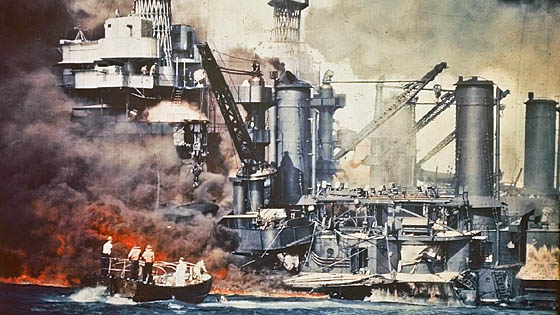
Pearl Harbor Day: How did Adolf Hitler react to the attack?
At the time of the attack, Japan was already one of the Axis powers, but Adolf Hitler did not know of its plans. On Pearl Harbor Day, a look back at the Führer's response - and subsequent miscalculation.
By Peter Grier, Staff writer / December 7, 2011
http://www.csmonitor.com/USA/2011/1207/Pearl-Harbor-Day-How-did-Adolf-Hitler-react-to-the-attack
Exactly 70 years ago Japan hit Pearl Harbor with one of the most stunning surprise attacks in history. At the time Japan was already one of the Axis powers, linked with Italy and Germany. Given that, how did the Führer, Adolf Hitler, react?
Hitler did not know of the Pearl Harbor plan beforehand. When informed in his headquarters on the evening of Dec. 7 of the strike and the damage suffered by US forces, he was “delighted,” according to British historian Ian Kershaw.
“We can’t lose the war at all. We now have an ally which has never been conquered in 3,000 years,” a jubilant Hitler said, as recounted in Mr. Kershaw’s authoritative biography of the German leader.
This comment was typical of Hitler in that it was both grandiose and a touch self-delusional. In fact, Hitler viewed the Japanese through the lens of his own racial prejudice. In “Mein Kampf” he patronizingly wrote that Japanese scientific and technical progress would cease without “Aryan” influence. His top lieutenants recalled that he accepted Japanese gains in the Far East with some resignation, and occasionally warned that eventually Germany would find itself in a showdown with what he called the “yellow race.”
But for Hitler, the Japanese triumph at Pearl Harbor came at an opportune time. Operation Barbarossa, the German invasion of the Soviet Union, had stalled. On Dec. 6, the Soviets had launched a counterattack that would eventually save Moscow and doom Hitler’s dream of an empire in the East.
Thus Hitler seized on Pearl Harbor as a light in the general gloom. His assumption was that the Japanese would now tie down the United States in the Pacific and weaken Britain by threatening its Asian possessions, according to Kershaw.
Germany and Japan had already agreed on a strengthening of their existing Tripartite Pact, which would bind each to declare war on a power attacking the other. This provision had not been formally signed, however, meaning that Hitler by treaty was required only to aid Japan, not enter the war against the United States.
But for Hitler this was a foregone conclusion – he wanted to ensure that Japan would stay in the war, and perhaps invade Russia from the east. He also felt that war with the US was inevitable, and he wanted to take the initiative. On Dec. 8, he ordered German U-boats to sink US ships on sight.
In a lengthy speech to the Reichstag on Dec. 11, Hitler recounted recent military events, excoriated President Roosevelt, and declared war on the United States. Given that US public opinion was far harsher about Japan than Germany, this was a mistake, writes British journalist and historian Max Hastings in his history of World War II, “Inferno.”
“Four days after Pearl Harbor, [Hitler] made the folly of the strike comprehensive by declaring war on the United States, relieving Roosevelt from a serious uncertainty about whether Congress would agree to fight Germany,” writes Mr. Hastings.
The Japanese, for their part, had begun the war with the US in the belief that Nazi Germany was an unstoppable force that would soon conquer the Soviet Union and end the war in Europe. So the Axis powers lurched forward, each blind to the particular strategic situation they now faced.
At the time of the attack, Japan was already one of the Axis powers, but Adolf Hitler did not know of its plans. On Pearl Harbor Day, a look back at the Führer's response - and subsequent miscalculation.
By Peter Grier, Staff writer / December 7, 2011
http://www.csmonitor.com/USA/2011/1207/Pearl-Harbor-Day-How-did-Adolf-Hitler-react-to-the-attack
Exactly 70 years ago Japan hit Pearl Harbor with one of the most stunning surprise attacks in history. At the time Japan was already one of the Axis powers, linked with Italy and Germany. Given that, how did the Führer, Adolf Hitler, react?
Hitler did not know of the Pearl Harbor plan beforehand. When informed in his headquarters on the evening of Dec. 7 of the strike and the damage suffered by US forces, he was “delighted,” according to British historian Ian Kershaw.
“We can’t lose the war at all. We now have an ally which has never been conquered in 3,000 years,” a jubilant Hitler said, as recounted in Mr. Kershaw’s authoritative biography of the German leader.
This comment was typical of Hitler in that it was both grandiose and a touch self-delusional. In fact, Hitler viewed the Japanese through the lens of his own racial prejudice. In “Mein Kampf” he patronizingly wrote that Japanese scientific and technical progress would cease without “Aryan” influence. His top lieutenants recalled that he accepted Japanese gains in the Far East with some resignation, and occasionally warned that eventually Germany would find itself in a showdown with what he called the “yellow race.”
But for Hitler, the Japanese triumph at Pearl Harbor came at an opportune time. Operation Barbarossa, the German invasion of the Soviet Union, had stalled. On Dec. 6, the Soviets had launched a counterattack that would eventually save Moscow and doom Hitler’s dream of an empire in the East.
Thus Hitler seized on Pearl Harbor as a light in the general gloom. His assumption was that the Japanese would now tie down the United States in the Pacific and weaken Britain by threatening its Asian possessions, according to Kershaw.
Germany and Japan had already agreed on a strengthening of their existing Tripartite Pact, which would bind each to declare war on a power attacking the other. This provision had not been formally signed, however, meaning that Hitler by treaty was required only to aid Japan, not enter the war against the United States.
But for Hitler this was a foregone conclusion – he wanted to ensure that Japan would stay in the war, and perhaps invade Russia from the east. He also felt that war with the US was inevitable, and he wanted to take the initiative. On Dec. 8, he ordered German U-boats to sink US ships on sight.
In a lengthy speech to the Reichstag on Dec. 11, Hitler recounted recent military events, excoriated President Roosevelt, and declared war on the United States. Given that US public opinion was far harsher about Japan than Germany, this was a mistake, writes British journalist and historian Max Hastings in his history of World War II, “Inferno.”
“Four days after Pearl Harbor, [Hitler] made the folly of the strike comprehensive by declaring war on the United States, relieving Roosevelt from a serious uncertainty about whether Congress would agree to fight Germany,” writes Mr. Hastings.
The Japanese, for their part, had begun the war with the US in the belief that Nazi Germany was an unstoppable force that would soon conquer the Soviet Union and end the war in Europe. So the Axis powers lurched forward, each blind to the particular strategic situation they now faced.
Sunday, December 9, 2012
3 Enduring Mysteries of Pearl Harbor
http://www.csmonitor.com/USA/2011/1207/Pearl-Harbor-Day-2011-three-enduring-mysteries
Pearl Harbor Day 2011: three enduring mysteries
On Pearl Harbor Day, historians continue to debate the mysteries of Pearl Harbor. The Japanese attack created some of the great unanswered questions of military history.
Pearl Harbor. In the United States, the name alone means surprise, defeat, and the rise of common purpose from ashes. Seventy years on, the Japanese surprise attack on US forces assembled in Hawaii remains one of the American people’s most powerful historic memories.
Every year on Dec. 7 the nation pauses to remember the 2,400 US personnel who died that day, and the generation of ordinary citizens which picked up Pearl Harbor’s fallen flag and fought to victory in World War II.
“We look to December 7, 1941, to draw strength set by the example of these patriots and to honor all who have sacrificed for our freedom,” said President Obama in his proclamation for Pearl Harbor Remembrance Day 2011.
But seven decades later, Pearl Harbor also remains a mystery. More specifically, it remains an event that has produced some of the great unanswered questions of military history.
Why did the Japanese attack a nation whose industrial might was an order of magnitude larger? Why didn’t the US see the signs that a strike was coming? Who in the US chain of command was most responsible for American unpreparedness?
Today, historians continue to debate many of Pearl Harbor’s puzzles, producing new evidence and theories. Here are just a few of those continued conundrums.
Why weren't US bases on alert?
The first wave of Japanese aircraft hit Pearl Harbor at about 8 a.m. local time on Dec. 7, 1941. Within hours, Japanese forces also struck the Philippines, Wake Island, Guam, and other Pacific targets. US units everywhere were taken by surprise.
“The nakedness of America’s Pacific bases continues to puzzle posterity,” writes British journalist and historian Max Hastings in his gripping new history of World War II, “Inferno.”
Mr. Hastings dismisses claims that President Franklin Roosevelt allowed Pearl Harbor to be attacked to draw the US into war. But he says it is nonetheless “extraordinary” that the US political and military leadership did not ensure that Pearl Harbor and other Pacific bases were on full precautionary footing.
The late Gordon Prange, a University of Maryland professor who was perhaps America’s foremost authority on the attack, believed that the core problem was that the US government did not in its heart believe that its own warnings about imminent Japanese aggression were true.
“This fundamental disbelief is the root of the whole tragedy,” concluded Mr. Prange in his book, “At Dawn We Slept.”
A congressional committee conducted extensive hearings into the Pearl Harbor disaster after the war ended. Among its conclusions were that Army forces were so focused on training they lost sight of possible attack – and that Army commanders were so worried about sabotage they locked up anti-aircraft ammunition rather than distribute it to gun sites. The Navy did not maintain aircraft patrols at sea due to lack of equipment – but neither did commanders order a picket line of surface ships instead.
In the current issue of Naval History, a journal of the US Naval Institute, historians Jonathan Parshall and J. Michael Wenger argue that an overlooked answer to the question of why the US was surprised is that US commanders did not understand how quickly aircraft carrier warfare was evolving.
The Pearl Harbor strike plan involved the melding of planes from many carriers into a hornet swarm of attackers. That was a skill the US did not know the Japanese military possessed.
“The US Navy had no real inkling of Japanese carrier warfare capabilities and therefore could not accurately assess likely operational targets,” write Messrs. Parshall and Wenger.
Why didn't the Japanese press their advantage?
After two waves of aircraft devastated Pearl Harbor’s Battleship Row and US air bases, Japanese pilots returned to their carriers in triumph. Adm. Chuichi Nagumo then led a discussion on whether another attack was feasible. Many air commanders supported such a follow-up, believing that fuel dumps, repair shops, and other US logistical sites were now vulnerable.
A cautious commander, Nagumo decided against more action. It would have required reloading aircraft on deck at sea at a time when the location of US carriers and submarines was unknown. Japanese forces had already won a spectacular victory. Why waste that gain?
“Nagumo’s decision to turn back came as a disappointment to many of his airmen, who wanted to exploit their opportunity,” wrote Prange.
Destruction of Pearl Harbor’s infrastructure might have forced the US to withdraw its naval forces to the US West Coast. For decades, some historians have argued that Nagumo missed an opportunity that maybe, just maybe, could have turned the course of the war.
However in his book, “Inferno,” Max Hastings argues that new research shows a follow-on attack was not feasible.
“The winter day was too short to launch and recover [another wave of aircraft], and in any event Japanese bomb loads were too small to plausibly wreck Pearl’s repair bases,” Mr. Hastings writes.
What would have happened if the US had won the battle?
How would the world have been different if US forces had been on alert that Sunday morning in December? After all, it would have taken only a few hours' early warning to perhaps reverse the battle’s decision. US fighters would have been aloft and anti-aircraft batteries alerted. They could have taken a large toll on Japan’s incoming planes.
Today’s conventional wisdom is that Japan, in winning the battle, lost the war. Many of the ships destroyed at Pearl were refloated and rebuilt for later fights. Most important, a US public that had been divided over entry into the war became united at a stroke.
“No more did Americans ask whose fight it was or question what they should do about it,” wrote Prange.
As Prange also notes, it is likely that the US would have entered World War II at some point even if Pearl Harbor never happened. Whether US civilians would have universally supported such a move in the absence of a surprise attack is a great historical unknown.
As to what might have happened if the Pacific Fleet had repulsed its attackers, it’s quite possible that the fleet’s commander, Adm. Husband E. Kimmel, would have launched his battleships and carriers out on a mission to catch and destroy the Japanese, writes Ohio State University military historian Mark Grimsley.
Kimmel was an offensive-minded commander who dreamed of replicating the victories of the great British admirals of the past. Within several weeks he could have gathered US naval power near Wake Island for a possibly decisive encounter.
Both sides would have had eight battleships available for a fight, writes Mr. Grimsley. The Japanese would have had a slight edge in aircraft carriers, but the US would have benefited from land-based planes from Wake Island bases.
The outcome would have been impossible to predict. A US victory could have greatly shortened the Pacific War. But “a decisive American defeat would have been far worse than the historical Pearl Harbor attack,” writes Grimsely. “Most of the vessels damaged or sunk [at Pearl] were subsequently repaired and returned to action, whereas any warships lost in the Central Pacific would have disappeared beneath thousands of feet of water,” writes Grimsley on Military History magazine’s website.
Pearl Harbor Day 2011: three enduring mysteries
On Pearl Harbor Day, historians continue to debate the mysteries of Pearl Harbor. The Japanese attack created some of the great unanswered questions of military history.
Pearl Harbor. In the United States, the name alone means surprise, defeat, and the rise of common purpose from ashes. Seventy years on, the Japanese surprise attack on US forces assembled in Hawaii remains one of the American people’s most powerful historic memories.
Every year on Dec. 7 the nation pauses to remember the 2,400 US personnel who died that day, and the generation of ordinary citizens which picked up Pearl Harbor’s fallen flag and fought to victory in World War II.
“We look to December 7, 1941, to draw strength set by the example of these patriots and to honor all who have sacrificed for our freedom,” said President Obama in his proclamation for Pearl Harbor Remembrance Day 2011.
But seven decades later, Pearl Harbor also remains a mystery. More specifically, it remains an event that has produced some of the great unanswered questions of military history.
Why did the Japanese attack a nation whose industrial might was an order of magnitude larger? Why didn’t the US see the signs that a strike was coming? Who in the US chain of command was most responsible for American unpreparedness?
Today, historians continue to debate many of Pearl Harbor’s puzzles, producing new evidence and theories. Here are just a few of those continued conundrums.
Why weren't US bases on alert?
The first wave of Japanese aircraft hit Pearl Harbor at about 8 a.m. local time on Dec. 7, 1941. Within hours, Japanese forces also struck the Philippines, Wake Island, Guam, and other Pacific targets. US units everywhere were taken by surprise.
“The nakedness of America’s Pacific bases continues to puzzle posterity,” writes British journalist and historian Max Hastings in his gripping new history of World War II, “Inferno.”
Mr. Hastings dismisses claims that President Franklin Roosevelt allowed Pearl Harbor to be attacked to draw the US into war. But he says it is nonetheless “extraordinary” that the US political and military leadership did not ensure that Pearl Harbor and other Pacific bases were on full precautionary footing.
The late Gordon Prange, a University of Maryland professor who was perhaps America’s foremost authority on the attack, believed that the core problem was that the US government did not in its heart believe that its own warnings about imminent Japanese aggression were true.
“This fundamental disbelief is the root of the whole tragedy,” concluded Mr. Prange in his book, “At Dawn We Slept.”
A congressional committee conducted extensive hearings into the Pearl Harbor disaster after the war ended. Among its conclusions were that Army forces were so focused on training they lost sight of possible attack – and that Army commanders were so worried about sabotage they locked up anti-aircraft ammunition rather than distribute it to gun sites. The Navy did not maintain aircraft patrols at sea due to lack of equipment – but neither did commanders order a picket line of surface ships instead.
In the current issue of Naval History, a journal of the US Naval Institute, historians Jonathan Parshall and J. Michael Wenger argue that an overlooked answer to the question of why the US was surprised is that US commanders did not understand how quickly aircraft carrier warfare was evolving.
The Pearl Harbor strike plan involved the melding of planes from many carriers into a hornet swarm of attackers. That was a skill the US did not know the Japanese military possessed.
“The US Navy had no real inkling of Japanese carrier warfare capabilities and therefore could not accurately assess likely operational targets,” write Messrs. Parshall and Wenger.
Why didn't the Japanese press their advantage?
After two waves of aircraft devastated Pearl Harbor’s Battleship Row and US air bases, Japanese pilots returned to their carriers in triumph. Adm. Chuichi Nagumo then led a discussion on whether another attack was feasible. Many air commanders supported such a follow-up, believing that fuel dumps, repair shops, and other US logistical sites were now vulnerable.
A cautious commander, Nagumo decided against more action. It would have required reloading aircraft on deck at sea at a time when the location of US carriers and submarines was unknown. Japanese forces had already won a spectacular victory. Why waste that gain?
“Nagumo’s decision to turn back came as a disappointment to many of his airmen, who wanted to exploit their opportunity,” wrote Prange.
Destruction of Pearl Harbor’s infrastructure might have forced the US to withdraw its naval forces to the US West Coast. For decades, some historians have argued that Nagumo missed an opportunity that maybe, just maybe, could have turned the course of the war.
However in his book, “Inferno,” Max Hastings argues that new research shows a follow-on attack was not feasible.
“The winter day was too short to launch and recover [another wave of aircraft], and in any event Japanese bomb loads were too small to plausibly wreck Pearl’s repair bases,” Mr. Hastings writes.
What would have happened if the US had won the battle?
How would the world have been different if US forces had been on alert that Sunday morning in December? After all, it would have taken only a few hours' early warning to perhaps reverse the battle’s decision. US fighters would have been aloft and anti-aircraft batteries alerted. They could have taken a large toll on Japan’s incoming planes.
Today’s conventional wisdom is that Japan, in winning the battle, lost the war. Many of the ships destroyed at Pearl were refloated and rebuilt for later fights. Most important, a US public that had been divided over entry into the war became united at a stroke.
“No more did Americans ask whose fight it was or question what they should do about it,” wrote Prange.
As Prange also notes, it is likely that the US would have entered World War II at some point even if Pearl Harbor never happened. Whether US civilians would have universally supported such a move in the absence of a surprise attack is a great historical unknown.
As to what might have happened if the Pacific Fleet had repulsed its attackers, it’s quite possible that the fleet’s commander, Adm. Husband E. Kimmel, would have launched his battleships and carriers out on a mission to catch and destroy the Japanese, writes Ohio State University military historian Mark Grimsley.
Kimmel was an offensive-minded commander who dreamed of replicating the victories of the great British admirals of the past. Within several weeks he could have gathered US naval power near Wake Island for a possibly decisive encounter.
Both sides would have had eight battleships available for a fight, writes Mr. Grimsley. The Japanese would have had a slight edge in aircraft carriers, but the US would have benefited from land-based planes from Wake Island bases.
The outcome would have been impossible to predict. A US victory could have greatly shortened the Pacific War. But “a decisive American defeat would have been far worse than the historical Pearl Harbor attack,” writes Grimsely. “Most of the vessels damaged or sunk [at Pearl] were subsequently repaired and returned to action, whereas any warships lost in the Central Pacific would have disappeared beneath thousands of feet of water,” writes Grimsley on Military History magazine’s website.
Subscribe to:
Posts (Atom)