Friday, April 15, 2016

18th-century gravestones dug up near historic KL mosque

An old drawing of Masjid Jamek with the staircase used as a landing area for those arriving by sampan. - Photo used with permission of Malaysian Institute of Architects (PAM)

An old drawing of Masjid Jamek with the staircase used as a landing area for those arriving by sampan. -Malaysian Institute of Architects (PAM)

HISTORY has literally been dug up at the confluence of the two rivers that inspired the name of Malaysia’s capital Kuala Lumpur.

A staircase adjoining Masjid Jamek, long forgotten in the face of modernisation and development, has been unearthed after works for the River of Life project in the area commenced.
At a glance, it seems a disconnected structure but further digging showed there was more to it than it seems.
Malaysian Institute of Architects (PAM) heritage conservation committee member and architect Mariana Isa said the staircase was part of the original mosque design from more than a hundred years ago.
“In all early photographs and drawings of the mosque, designed by Federated Malay States’ Public Works Department assistant architect A.B. Hubback, the staircase is featured quite prominently. The mosque was officially opened by Sultan of Selangor Sultan Alauddin Sulaiman Shah in 1909,” she said.
The site had originally been a Malay cemetery that was relocated to Jalan Ampang in order to build the mosque.

The mosque was built to cater to the growing population as well as to replace a nearby mosque that was demolished to make way for a road widening project.
A perspective painting of the mosque that had been in the possession of Hubback’s grandson Dr Peter Barbor showed that the steps were imagined to be a place of human activity as well as a landing spot for sampans, an important mode of transport in the past.
“It would not be impossible to believe that people would also perform their ablutions at the steps with the river water.’’
“It was not until other land transportation such as the train system began developing that the steps slowly started to disappear,” she said, adding that the mosque was built using funds collected among the Malays, the Sultan as well as the British government.
In photos as early as the late 1930s, the river bank had been shored up and the lower half of the steps concealed under the soil.
The recently unearthed steps adjoining Masjid Jamek leads to the discovery of lost history.
The perimeter walls, originally designed to directly touch the water, was also half hidden behind a bank of soil.
“It was around the time when the LRT was being built that the concrete river bank was built and with it the steps all but disappeared except a few at the very top,” said Mariana, who is also a committee member of the recently established Malaysia branch of non-governmental organisation International Council on Monuments and Sites.
Mariana also said that the spot, a confluence between Sungai Gombak and Sungai Klang, had an earlier historical importance as the place the first settlers landed.
DBKL Project Implementation and Maintenance deputy director-general Datuk Mohd Najib Mohd said they were excited with the discovery of the staircase.
“It was unexpected and the plan has shifted a little to include it as part of the River of Life (RoL) rejuvenation plans in the area. This area already has quite a nostalgic air but this staircase can increase this value and also connect us to the city’s past,” he said.
“The Malaysian Historical Society has been asked to help us study the steps. It is about 80% intact while the rest seems to have been damaged during a river deepening project many years ago.
“We are looking into putting some kind of protective coating over the staircase to maintain it. Meanwhile, the contractors doing work near the staircase are not allowed to use machinery and are instead digging manually,” he said.
Moghul architecture: Masjid Jamek, Kuala Lumpur’s oldest mosque at the confluence of the Klang and Gombak rivers. It was built in 1907 and officially opened by the Sultan of Selangor on Dec  23, 1909.
Moghul architecture: Masjid Jamek, Kuala Lumpur’s oldest mosque at the confluence of the Klang and Gombak rivers. It was built in 1907 and officially opened by the Sultan of Selangor on Dec  23, 1909.
Mariana said Masjid Jamek belonged to the people and nothing from the original design should be removed to retain its full historical value.
“Not even a single pillar should be removed. I had been upset when some of the coconut trees that had been growing in the mosque’s compound were removed.
“Coconut trees had been growing there even during the time the place was a cemetery. This place is like a time capsule that should be preserved as a whole,” she said, adding that it was the little things that made the place unique.”
“The mosque had been the identifying icon of Kuala Lumpur in the times before skyscrapers came about in the city.”
“It was replicated to represent Malaya during the British Empire Exhibition back in 1924. It even made it into an international architecture publication,” she said, adding that the site should belong to the people.
http://www.thestar.com.my/news/community/2014/10/28/mosque-well-preserved-at-105-years-old/

18th-century gravestones dug up near historic KL mosque


KUALA LUMPUR • More than 45 gravestones that are believed to be from the early 18th century have been discovered at a construction site near the historic Jamek Mosque.
These gravestones are mostly made of granite, with a few made of marble and sandstone, The Star newspaper reported yesterday.
The writing was still legible on some of the gravestones, which date back nearly 200 years and were unearthed between December last year and last month, the report added. The mosque's head administrator Mohd Faisal Tan Mutalib said: "These are exciting discoveries. Our knowledge of the area's history is limited, but what we do know is that there was a Muslim graveyard here in the early 18th century."
He added: "It is not surprising to find old gravestones in this area. Some are quite grand and beautiful. They need to be documented."
The gravestones that have been recovered have been tagged and will be studied, although it is not clear which party will be in charge of this study.
The construction works are part of the RM4.4 billion (S$1.5 billion) River of Life project announced in 2012 to turn the Klang River into a vibrant waterfront.
The entire river is being cleaned up, and beautification and development works are being carried out along a 10.7km stretch in downtown Kuala Lumpur.
The 108-year-old Jamek Mosque is also undergoing major upgrading works as part of the project.
The area had been the centre of commercial activity as early as the 18th century, and was inhabited by early settlers who did tin mining work for a living.
The Jamek Mosque area and its surroundings have been declared a National Heritage site by Malaysia's National Heritage Commission.
Workers who are now building a water fountain at the site have been alerted to look out for more artefacts that may emerge, and to report any new findings to the commission.
A consultant with construction firm Ekovest, one of the companies in charge of the River of Life project, said: "We have been finding all sorts of artefacts from the project site since late last year. First it was broken ceramic bowls, glasses, bottles, and pots."
"Some of the gravestones looked quite fancy, while others had Jawi scripts embossed on them," he added, referring to the Arabic alphabet which Malay was written in before it was romanised.
THE STAR/ASIA NEWS NETWORK

Monday, March 21, 2016

Teng Voon Kong Memorian Booklet Writeouts


Teng Voon Kong


Teng Voon Kong Funeral Procession and Other Photos

1929 Gathering


1931 Funeral Procession


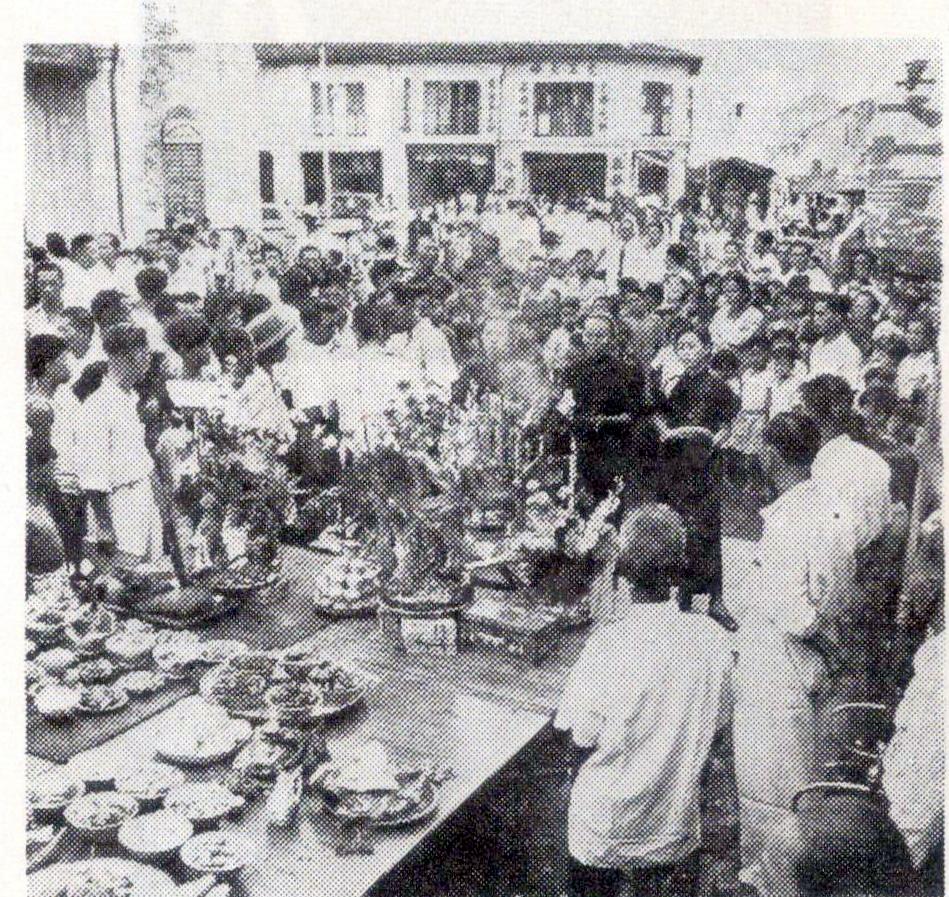
The following are photographs of the funeral for  Teng Voon Kong in May 1956 published in a booklet (published in Sept 1956) 


Teng Voon Kong: Will and Life Story (12 Aug 1880 - 10 May 1956)

I am named JOO FAT and VOON KONG. I was born in China, Kwangtung Province, Tai Pu District, North Section of the New Village there. I was born in the year of the Reign of the Emperor Kwong Sui (Guangxu), Chinese Year Ken Sin, on the seventh day of the seventh moon at Chi hour (about 12 o'clock), that is, in A.D. 1880.


The Teng Family of Tai Pu

The Teng family had been living in the New Village of Tai Pu for more than six hundred years, and I am already in the twenty-first generation, so long is our history. In feudal times of the past, there was a Lu Min Chi (Clan House) built and a family record was made of the ancestors of our surname.

My grandfather Kguk Kwei of the nineteenth generation was a farmer. When the overseas routes were open, many from our village went abroad to find a living, and (my) grandfather allowed my father, Shin Wong, to ome south to earn a living in Singapore where he underwent many sufferings. After several years, he (my father) established the Toong Shin Blacksmith Shop in Singapore.

Shin Wong


The Teng Family in Singapore

In Wang Sui Wei Chi Year in summer, that is in A.D. 1892, when I was fourteen years old, I received instructions from my father to accompany my mother, Nee Chai, to come south to Singapore so that the family could be together. When I first arrived in Singapore, because of the climate in the tropics, I was suddenly infected with a fevver that was with me for half a year. I was in a serious condition. My parents were very anxious and grieved, ut could do nothing. Fortunately, an old Chinese physician, Chou Mui Chun, treated me and unexpectedly I recovered as soon as I took his medicin, regaining my original health gradually; my parents were very happy. When I was fifteen years old, I entered (into) a private old type school for three years.

Travelling Between Singapore and China

When I was eighteen, I returned to China in (the) winter (of A,D. 1898).  In spring the following year, I married Lai Chong Neong and remained at home (in China) for two years.


In Kee Hoi Year, that is A.D. 1899, I had  my second son Sook Kin.

 In Sin Chiu Year, that is in A.D. 1901, I came south to learn about the fruit and sweet meat (provision shop) business.

In Kin Yien Year in summer, I followed my father back to the village to visit my grandfather. My father returned south first because of his business, and I remand behind to look after my grandfather.

In Kwei Meu Year, that is 1903, I had my third son, Sook Kam.

 In autumn of 1903, I suddenly receive the bad news of my father's death and I had to leave my grandfather to return south to take over and continue my late father's business.

In Pin Ng Year in winter, I also received the bad news of the death of my 89 year-old grandfather at home in the village. I immediately went north for the burial

In the Ting Wei Year in spring, I returned south again and thereafter I was tied up with my business and had no opportunity to return to the village. I then told my wife, Madam Lai, to come with my three sons to Singapore.

In Yim Chi Year, that is in A.D. 1912, I obtained (had)) my fourth son, Sook Chio (Ling Siong).

In Kwei Chui Year, that is A.D. 1913, I obtained my fifth son, Soon Nyien (Foong Siong). Unfortunately my oldest son, Sook Kien, suddenly died of illness. My wife, Madam Lai, was aggrieved by this event and went to seek advice of the gods, with the result that the idea of a second marriage came to me.

Second marriage and 'the evening years of my life'

In Kap Yien Year in winter, I married Chong Swee Neong as my second wife. From then on, the family was peaceful and we lived together without any difference in rank.


In Nget Meu Year, that is A.D. 1915, Madam Chong gave me my sixth son, Sook Kye (Sin Min).

In Ken Shin Year, that is in A.D. 1920, I got my seventh son, Sook Fah.

In Meu Sin Year, A.D. 1928, I had my eighth son, Sook Fay, who died early.

In Keng Ng Year, A.D. 1930, I had my ninth son, Sook Yan (Min). One of my sons was given in adoption to the Lu family and named Chin Kiat.

Two daughters were born to me. The elder, Li Hoon, was iven in adoption to the Tan family. She married Chow Eng Cheong; the second, Soon Poh, was married to Chia Hock Shi. From then on, I went through many difficulties to bring up my group of childre, but fortunately all of them are grown up, have their own families, and have something to depend on for their living. My regret, however, is that Heaven did not favour me. My two wives Madam Lai and Madam Chong died one following the other. I then married Sim Cheng Neo to pass the evening years of my life.


Family Lineage

My parents had three sons, the eldest, Choon Fatt, the second Chin Fatt. Both elder brothers also have many children and grandchildren. They each have their families and means of living. I am the third in my family, and I have four generations of descendants with more than sixty male and female grandchildren and great grandchildren, which is in fact of some consolation to me.

My Regret and Contributions

My regret is that during my life, I have had no great ambitions and have made no great contributions to society, but I have always done my utmost to work sincerely for organisations that benefit Overseas Chinese. In the past, through the love and respect of my clansmen, I have been on the Board of Directors of the Khek Community Guild, the Char Yong Association, the Khee Fatt Chinese School, the Fui Choon Hospital, the Khiaw Sin People's School, The Char Yong Li Chi Sar, the Smithy Association, the Teng Clan Association, etc. But now, I have resigned (from those positions) because of age. With regards to (the) benevolent activities in our native village, I have neither heard nor asked about matters there and know little of conditions there, because I have been away from home for many years.

Later, in the 35th year of the Republic (of) China (1946), I received a letter from the elders of the Ng and Teng Clans in our village saying that they intended to build a New Village Public School, and appointed me as the person responsible for collecting donations overseas. I was to appeal to clansmen in Singapore and the Federation for funds. The result was quite satisfactory and I remitted the whole sum collected back to the village, thus fulfilling my duties in a small way towards the building up of our village.

In the 36th year of the republic of China (1947), when the Tai Poo North Middle School of our village wanted to erect new school buildings, a special emissary was sent south to collect funds. As my financial means were limited, I offered only $500/= (Straits currency). But because of my regard for education, I did what little I could by going everywhere with the emissary to ask for donations. It was a great success and the buildings were erected.

In A.D. 1950, I received a letter from a nephew in the village asking me to help to repair our clan house, which had been in disrepair for many years. As I could find no other means, I contributed more than $2,000.00 (Straits dollars) and the repairs were completed. The relatives in the village, having no other means to replay me in gratitude, asked for my photograph to be hung up in the hall as remembrance.

Following this, the teachers and students of Tai Poo North Middle School have sent to me a congratulatory verse and birthday greetings every birthday (I have), because of the love of my clansmen. I feel ashamed to receive such tokens of friendship and deep sentiments.

Looking Back

I have come from China and have benefited from its thousands of years of great culture and tradition, and I have never forgotten by country. In fact, so great is our country and so excellent is the culture of the Chinese nation that all descendants of this great Chinese nation should preserve and develop this culture as a matter of duty.

I am now old and will certainly die in a foreign land. I will not have an opportunity to see my native land again. At present, Malay and Singapore are also fighting for self-government and independence and to build its own nation. Undoubtedly, my children and descendants will also become citizens of Malaya.  Because of their livelihood and external circumstances, this is only a natural situation. But I do not wish (for) my children to forget the culture and traditions of the Chinese race.

According to Chinese tradition and moral teaching, we have to think of the "root of trees and source of water". I wish that my children and descendants will remember this well. In future, whatever forms of livelihood my children and descendants may take, they must preserve and develop the splendid traditions and culture of the Chinese race to be worthy of being included among the descendants of myself, Teng Voon Kong. This is my desire.

My ninth son, Sook Yan (Min) was born in Singapore. At the end of 1950, he was repatriated, on his own request, to China by the Colonial Govt. for his anti-Colonialism activities. He is now . He is now living in the City of Chengchow, Honan Province, renering serice to his motherland. It is unlikely that he will ever return to Malaya and therefore must establish his occupation there. I am extremely glad to note that a member of my descendants (my son) is taking part in the progress and development of our country. I earnestly desire that my children and descendants residing in Malaya will have closer contact with him so that future generation(s) of (my) descendants will have no difficulty in tracing the origin of our ancestry.

Written in my own handwriting
at residence in Singapore

TENG VOON KONG
(Signed and Sealed)

KYE/-

NOTE: This work was completed by the author one week before his death on 10th May 1956.